

What Happens to Sperm After It’s Frozen? The Science Behind Cryopreservation
Sperm cryopreservation is one of the most established and reliable tools in reproductive medicine. Whether you’re preserving fertility before a medical procedure, planning for the future, or preparing for an upcoming IVF or IUI cycle, understanding what happens to sperm after it’s frozen can help you make more informed decisions and feel confident in the process. Here’s a clear, step-by-step look at the science behind cryopreservation.
Step 1: Collection and Analysis
Before a single cell is frozen, a sample has to be collected and evaluated. Collection typically occurs via masturbation into a sterile cup at a clinic or fertility lab; however, in some cases, you can produce a sample at home and turn it into the clinic within 24 hours. Once the sample is collected, sperm are separated from seminal fluid, and it is analyzed by specialists under a microscope to test for shape, motility, and concentration (the number of sperm per milliliter of semen). The results of this test will not only determine if the sperm is healthy enough to freeze, but also if the sperm will be viable post-thaw.
Step 2: The Cryoprotectant Shield
Here’s where things get biochemically interesting. Before freezing, sperm are mixed with a cryoprotectant, or a specialized solution designed to protect cells from the damage that occurs if ice crystals form. The cryoprotectant gradually replaces much of the water inside and around the cells, reducing the chance that ice forms inside the cell membrane during freezing. This step is carefully timed and dosed, because too much cryoprotectant is actually toxic to sperm as well.
Step 3: Controlled-Rate Slow Freezing
Unlike eggs and embryos, which are typically frozen using a rapid technique called vitrification, sperm are frozen using a method called controlled-rate slow freezing. The distinction matters. Vitrification flash-freezes cells so quickly that water molecules don’t have time to form ice crystals — instead, they solidify into a glass-like state. It’s highly effective for eggs and embryos, which are much larger and more structurally complex. Sperm, however, are extraordinarily small and simple in structure, meaning they actually respond better to a slower, more controlled descent in temperature.
During controlled-rate freezing, a programmable freezer lowers the temperature in precise increments, typically dropping a few degrees per minute. This measured pace gives the cells time to adjust and minimizes stress on the membranes. Once the sample hits that intermediate cold point of -80° C, it’s transferred to liquid nitrogen storage.
Step 4: Liquid Nitrogen Storage
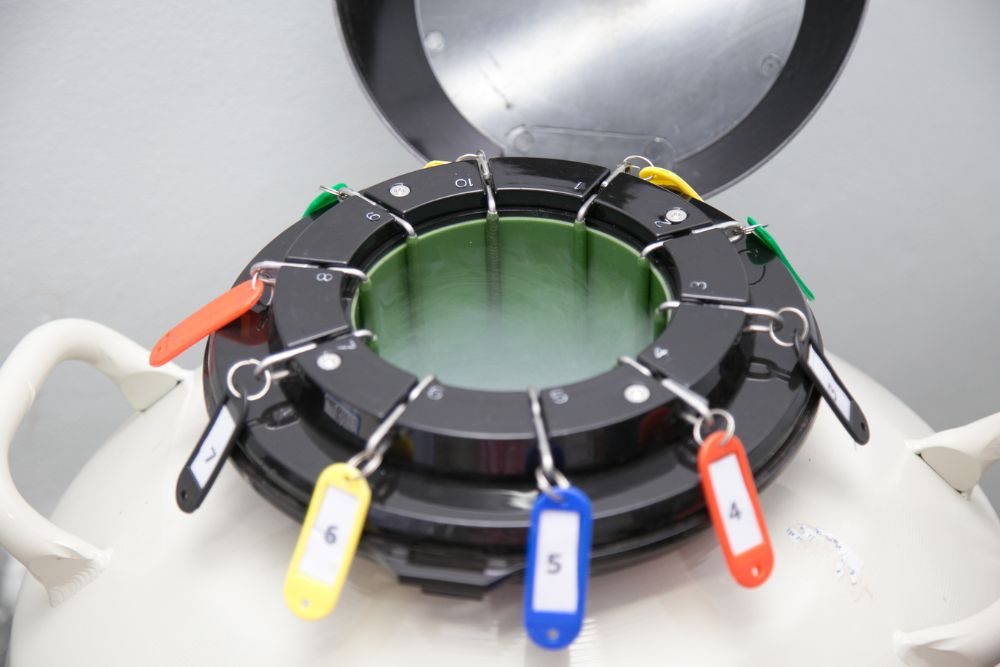
At -196° C, or the boiling point of liquid nitrogen, biological activity essentially stops. This is the key to why frozen sperm can remain viable for years, resulting in successful pregnancies many years later. The cells are housed in labeled cryovials inside large insulated tanks, which maintain the temperature as long as they’re kept filled with liquid nitrogen.
After the Thaw: What to Expect
Freezing and thawing isn’t a zero-loss process. On average, thawed sperm samples show a 50% reduction in motility compared to the fresh sample, meaning some cells don’t survive the journey. That sounds concerning, but it’s a well-understood and accounted-for variable in fertility medicine. For IUI (intrauterine insemination), labs select samples with sufficient post-thaw counts and progressive motility to give the procedure a realistic shot. And for IVF, even a small number of viable cells is all that’s needed.
Before releasing a frozen sample for use, specialists thaw the sample to room temperature and assess post-thaw motility and concentration. The samples that don’t meet threshold standards are flagged rather than used, protecting patients from failed cycles based on poor-quality material.
The Bottom Line
Cryopreservation is a careful science designed to give cells the best possible chance of surviving an extreme environment. With the right cryoprotectant, a controlled freeze, and rigorous post-thaw evaluation, frozen sperm can perform meaningfully in assisted reproduction. It’s one of the most dependable tools in modern fertility care, and understanding the process behind it can make the whole experience easier.
Interested in learning more about the sperm preservation process? The Fertility Center of California is here to help. We'll answer any questions you may have and guide you through each step. Contact us today!